Family 100 · Borosilicate glassware
Beakers, flasks, cylinders, funnels.
Every capacity below is the nominal volume the maker prints on the glass; every class is the one marked on it. Where a family has no tolerance class, its scale is for indication only, and the line says so.
Beakers
Graduated for indication. No tolerance class in this family.
Beaker, low form, with spout
The everyday form: squat, wide mouth, spout on the rim. The wall is uniform so the beaker takes a hotplate without shock.
25 ml · 50 ml · 100 ml · 150 ml · 250 ml · 400 ml · 600 ml · 800 ml · 1 l · 2 l · 3 l · 5 l
scale for indication only
Beaker, tall form, with spout
Narrower and taller for the same volume: less surface, less splash, and it stands better in a crowded rack.
50 ml · 100 ml · 150 ml · 250 ml · 400 ml · 600 ml · 800 ml · 1 l · 2 l
scale for indication only
Beaker, heavy wall
A thicker wall for benches where beakers are knocked, stacked and washed hard. Heavier in the hand and slower to heat.
250 ml · 600 ml · 1 l · 2 l · 5 l
scale for indication only
Conical flasks
Graduated for indication. Stoppers and joints listed on the line.
Conical flask, narrow neck
The flask that swirls without spilling. The narrow neck takes a rubber or cork stopper by size number.
25 ml · 50 ml · 100 ml · 250 ml · 500 ml · 1 l · 2 l · 3 l · 5 l
stopper size on request
Conical flask, wide neck
A wider mouth for filling through a powder funnel and for cleaning with a brush.
50 ml · 100 ml · 250 ml · 500 ml · 1 l · 2 l
scale for indication only
Conical flask, ground-glass joint
A standard-taper socket at the neck so a stopper, adapter or condenser seats without a bung. The joint size is given on the line.
100 ml · 250 ml · 500 ml · 1 l
joint size as listed
Filter flask, side arm
Heavy wall, a side arm for a vacuum line, and a neck that takes a stopper carrying a funnel. Not graduated.
250 ml · 500 ml · 1 l · 2 l
unmarked
Volumetric flasks
Class A and Class B, each with the matching stopper.
Volumetric flask, Class A
One ring mark at the nominal volume, made to contain at the reference temperature. The tolerance figure is printed under the mark by the maker.
5 ml · 10 ml · 25 ml · 50 ml · 100 ml · 250 ml · 500 ml · 1 l · 2 l
Class A, tolerance as printed
Volumetric flask, Class B
The same form, with twice the permitted deviation of Class A on every size. The usual choice for teaching benches and rough work.
10 ml · 25 ml · 50 ml · 100 ml · 250 ml · 500 ml · 1 l · 2 l
Class B, tolerance as printed
Stopper for a volumetric flask
Polyethylene or ground glass, by the joint size moulded into the neck. Listed on its own so that a lost stopper does not mean a new flask.
joint size as listed
sold separately
Measuring cylinders
Class A and Class B, hexagonal base, pour lip.
Measuring cylinder, Class A
Graduated to deliver, with the finer tolerance of the two classes. Tall and narrow: the taller the column, the finer the reading.
10 ml · 25 ml · 50 ml · 100 ml · 250 ml · 500 ml · 1 l · 2 l
Class A, tolerance as printed
Measuring cylinder, Class B
The working cylinder for most benches: twice the Class A tolerance, the same base and the same lip.
10 ml · 25 ml · 50 ml · 100 ml · 250 ml · 500 ml · 1 l · 2 l
Class B, tolerance as printed
Measuring cylinder, with stopper
A ground-glass stopper on a cylinder that has to be inverted to mix.
50 ml · 100 ml · 250 ml · 500 ml · 1 l
stopper included
Funnels and watch glasses
By diameter across the rim, in millimetres.
Funnel, short stem
A sixty-degree cone with a short stem, for beakers and wide-neck flasks.
40 mm · 55 mm · 75 mm · 100 mm · 150 mm · 200 mm
diameter across the rim
Funnel, long stem
The same cone with a stem long enough to reach into a narrow-neck flask, so the filtrate runs down the wall without splashing.
55 mm · 75 mm · 100 mm · 150 mm
diameter across the rim
Powder funnel
Wide throat, short stem, for dry solids into a flask neck.
60 mm · 80 mm · 100 mm · 120 mm
diameter across the rim
Watch glass
A shallow dish for covering a beaker or holding a small quantity of solid on a balance pan.
40 mm · 50 mm · 60 mm · 80 mm · 100 mm · 120 mm · 150 mm
diameter
Reading a tolerance class
What the letters on the glass mean, and what they do not.
Class A, Class B
Volumetric ware is made to one of two classes. Class A is the tighter; Class B is permitted twice the deviation of Class A on the same nominal volume. The figure itself is printed on the glass beside the class letter, as a plus-or-minus in millilitres, and it applies at the reference temperature that is printed there with it. The class is the maker’s statement; we copy it onto the price list and add nothing.
To contain, to deliver
A flask is marked to contain: the volume is what the glass holds when filled to the ring. A cylinder or a pipette marked to deliver is graduated for the volume that runs out, allowing for the film left on the wall. The letters that carry this distinction sit beside the class mark. Reading them the wrong way round is the commonest reason a bench orders the wrong piece.
What a class does not mean
A class mark tells you the limit the maker worked to. It does not tell you what any individual piece measures today, and it is not a certificate. If your work needs a measured value with a document behind it, that document has to come from a laboratory equipped to issue one; it does not come from a supplier, and it does not come from us.
Beakers and conicals
Beakers, conical flasks and funnels carry no tolerance class at all. Their scale is an indication moulded or printed on the wall so you can see roughly how much is in the vessel. Nobody should measure with them, and no price list of ours will describe them as measuring glass.
What we never claim
Said on every page, in case this is the only one you read.
Calibration
None. The figures on the glass are the maker’s, and they are repeated, not verified.
Not offered
Certification
None claimed, none issued, none implied by a class letter or by anything on this site.
Not offered
Medical or diagnostic use
Nothing in this family is sold for medical, diagnostic, clinical or veterinary use, whatever the list says.
Not sold for it
Repair
We do not repair, cut or anneal glassware. A cracked piece is replaced, not mended.
Not offered
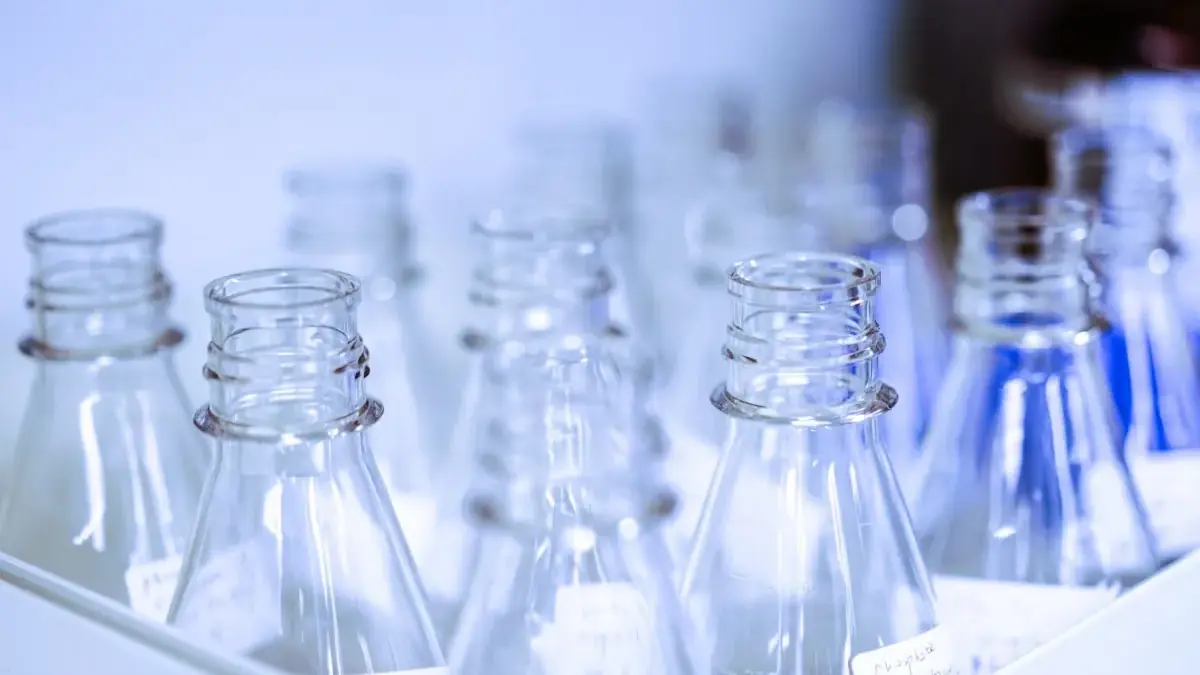
Plate 2
Narrow-neck conical flasks on the packing tray, before the dividers go in.